
Use the Hidden album as a private album
An album you make in Photos has no lock. The Hidden album does. The Photos app locks the Hidden album by default, and the album opens with Face ID, Touch ID or your iPhone passcode. In the Photos app, the Hidden album is under Collections, then Utilities, next to the Recently Deleted album. The Hidden album holds photos and videos. Hiding moves a photo out of your library into the Hidden album, and nothing is deleted. To hide photos, follow How to hide photos on iPhone.
Make a folder of locked notes
The Notes app locks notes one at a time, and a note can hold photos. A folder of locked notes works like a private folder, with 2 limits. A note with a video, a recording, a PDF or a document in it can’t be locked. And the title of a locked note still shows in the folder, so use titles you don’t mind anyone reading.
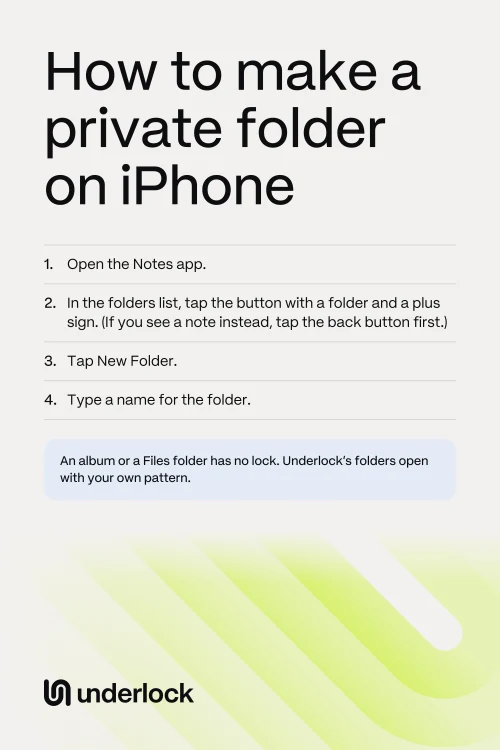
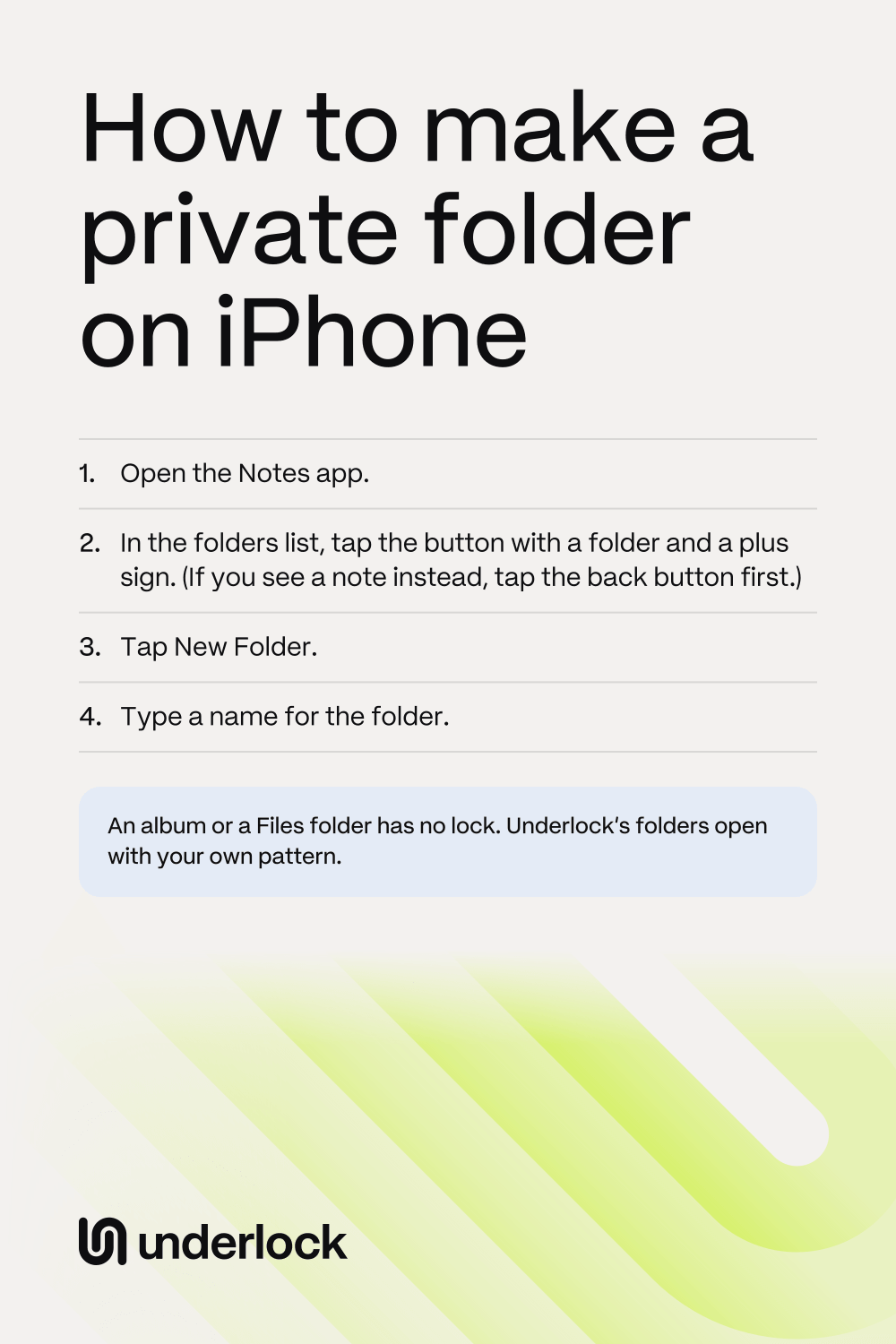
- Open the Notes app.
- In the folders list, tap the button with a folder and a plus sign. (If you see a note instead, tap the back button first.)
- Tap New Folder.
- Type a name for the folder.
- Tap the new folder to open it. Then tap the New Note button (a square with a pencil).
- Tap the Attachments button (a paper clip), then choose your photos.
- Tap the Note Actions button (three dots), then tap Lock. Lock adds a lock to the note, but the note stays open.
- The first time, choose how your notes lock: with your iPhone passcode, or with a password just for Notes. If others know your passcode, choose a Notes password. If you forget a Notes password, Apple can’t help you open notes locked with it.
- To lock the note now, tap the lock icon at the top of the note.
- To check the note, go back to the notes list and tap the note. Tap View Note, then use the passcode or Notes password you chose in step 8. Check that your photos are there.
- In the Photos app, delete the original photos. Then delete them again in Recently Deleted: tap Collections, then scroll to Utilities and tap Recently Deleted. After this, the locked note holds the only copy of these photos, so if you forget a Notes password, nobody can open these photos. With Apple’s iCloud Photos, the originals are deleted on your other devices too.
Lock each note you add to the folder. Notes locks an open note again when you close Notes or your iPhone goes to sleep. To let Face ID open your locked notes, open the Settings app and tap Apps, then Notes, then Password, and turn on Face ID.
Make a folder in the Files app
The Files app keeps documents and other files in folders, so the Files app suits papers more than photos. A folder in Files has no lock, but on iOS 18 or later you can lock the whole Files app. To see your iOS version, open the Settings app and tap General, then Software Update. Looking there doesn’t install anything.
- Open the Files app.
- Tap Browse, then tap a place such as iCloud Drive.
- Tap the More button (three dots in a circle), then tap New Folder.
- To name the new folder, touch and hold the new folder, then tap Rename.
- To move a file into the folder, touch and hold the file. Tap Move, then choose the folder.
- To lock the Files app, go to your Home Screen. Touch and hold the Files app until a menu opens.
- Tap Require Face ID. (Some iPhones say Require Touch ID or Require Passcode.)
- A box opens and asks you to confirm. Tap the same choice again in that box. Then use Face ID, Touch ID or your passcode.
The lock covers the whole Files app, not one folder. If New Folder doesn’t show in step 3, that place can’t hold a new folder, so choose another place, such as iCloud Drive.
What these folders don’t do
Apple’s options are built in and free, but none of them locks a folder you make:
- Albums and Files folders don’t lock. You can lock the whole Files app, but not one folder in it.
- Your iPhone passcode opens the Hidden album and a locked Files app, and so do Face ID and Touch ID. Locked notes open with your passcode too, unless you choose a Notes password.
- Notes can’t lock videos. A note with a video, a recording, a PDF or a document in it can’t be locked.
- An app lock doesn’t reach your other devices. Locking the Files app on your iPhone doesn’t lock Files on your iPad. Locked notes and the Hidden album do stay locked on your other devices.
If you’re the only one who knows your passcode, Apple’s options may be all you need.
Make folders behind your own pattern
A vault app keeps files behind a lock of its own. Underlock is the vault app we make: a private vault on your iPhone for photos, videos, files and notes. Your vault opens with your own pattern, not your iPhone passcode or Face ID. Inside your vault, you can make folders.
Underlock is coming soon to the App Store. Here’s how it will work.
- Open Underlock. Tap Get started.
- Draw a pattern on the grid, connecting at least 6 dots. Then draw the same pattern again.
- Write down the 12 words Underlock shows you. These 12 words are your recovery phrase: they get you back in if you forget your pattern. Keep the paper somewhere safe.
- Underlock then asks for 3 of your words, such as words 3, 7 and 11. For each one, tap the matching word on the screen.
- Tap Add (the plus at the bottom right), then Import from Photos or Import from Files. Choose what to import. Keep Underlock open until the import finishes. Leaving Underlock stops the import, but files already imported stay in your vault.
- When Underlock asks about the originals, tap Remove. Confirm if your iPhone asks. The originals then wait in Recently Deleted, in the Photos app or the Files app, for 30 days, so nothing is lost yet. If you use Apple’s iCloud Photos, removed photos also move to Recently Deleted on your other devices.
- Tap Folders, then tap New folder. Type a name for the folder. Tap Create.
- The new folder opens. Tap Move files here. Tap each file you want in the folder, then tap the Move button.
- Check that your files are in your vault. Then delete the originals from Recently Deleted in the Photos app or the Files app. Anyone with your passcode can open Recently Deleted in the Photos app.

Your folders sit inside your vault, so your vault’s pattern opens every folder. Files in a folder still show in your vault’s All tab. If you lose both your pattern and your 12 words, nobody can open your vault, not even us.
Questions people ask
Not an album you make: albums in Photos have no lock. The Hidden album is locked, and it opens with Face ID, Touch ID or your iPhone passcode.
Not one folder. On iOS 18 or later, you can lock the whole Files app, which then opens with Face ID, Touch ID or your passcode.
Not the folder itself. Notes locks each note, and a locked note’s title still shows in the folder.
Use a locked note. iPhone has no password for a folder or an album, but a note can lock with a Notes password. In Underlock, your vault’s pattern opens every folder in your vault.
No. Folders sit inside your vault, and your vault’s pattern opens all of them. For a second pattern, you need a second vault: more vaults come with Pro, Underlock’s paid plan.