
What’s changed in 2025 and 2026
Phone searches at the US border have been in the news. Here is what changed, with the date of each fact:
- US searches hit a record. From April to June 2026, CBP searched the devices of 19,732 travellers. That is more than in any other 3 months on CBP’s page. From October 2025 to June 2026, CBP searched 52,081 travellers’ devices, about a third more than a year before.
- CBP has new rules. CBP’s rules for searching devices were updated on 1 January 2026. The 2 kinds of search below stay the same. The new rules also name more devices, like smart watches and SIM cards.
- US courts said officers need no suspicion. In 2026, 3 US appeals courts ruled that officers don’t need any suspicion to look through a phone by hand at the border. The latest ruling came on 17 September 2026.
- The Supreme Court hasn’t ruled. On 29 September 2026, the US Supreme Court asked the government to answer one traveller’s request to hear a border phone case. The answer is due by 30 November 2026.
- Canada warned travellers going to the US. In April 2025, the Government of Canada added a part about phones to its travel advice for the United States. It says US border agents don’t need to give a reason when they ask for a password.
- Visitors’ social media may be checked. In December 2025, CBP proposed asking visitors who travel with an ESTA for their social media from the last 5 years. ESTA is the online travel permission many visitors get instead of a visa. On 10 November 2026, the US government’s Federal Register still showed the change as a proposal.
- Some visitors were turned away after a phone search. In 2025, news outlets reported visitors refused entry to the US after officers looked through their phones. The travellers, or their governments, linked the refusals to messages or photos on the phones. The US Department of Homeland Security gave other reasons.
- Canada’s law hasn’t changed. Courts in Alberta in 2020 and in Ontario in 2024 ruled that Canada’s customs law sets no limit on phone searches. They said that breaks Canada’s Charter of Rights and Freedoms. A bill to set a limit died in January 2025. On 10 November 2026, no new bill had replaced it.
Phone searches are still rare in both countries. CBP counts its year from October to September. In its 2025 year, CBP searched the devices of 55,318 travellers, out of more than 419 million.
What US border officers can search
CBP’s rules allow 2 kinds of search, for every traveller, US citizens included. Here is what CBP’s rules say:
- A basic search. An officer looks through what’s on your phone by hand, like your photos and messages. CBP says officers can do this even when they suspect nothing. In CBP’s 2025 year, 92% of searches were basic.
- An advanced search. An officer connects equipment to your phone, to copy or analyze what’s on it. CBP says this needs a reasonable suspicion that a law was broken, or a national security concern. A senior supervisor also has to approve it.
- Only what’s on the phone. CBP says officers search only what’s stored on the phone. They may not use the phone to open information that is stored only online. Before a search, officers ask you to turn off the phone’s connections, for example with Airplane Mode, or they turn them off themselves.
- Your passcode. CBP says travellers are obligated to present a phone in a condition that lets officers examine it. So an officer can ask you to unlock your phone, or for your passcode. If an officer writes down your passcode, CBP says the officer deletes it once the search no longer needs it.
- Before and during the search. CBP says officers tell you about the search before it starts, often with a printed sheet. The search usually happens with you in the room, but you may not get to watch.
- Copies. CBP says it keeps no copies after 21 days, unless the information may be evidence, or matters to its work enforcing the law. CBP can keep that information for up to 15 years.
If you say no at the US border
CBP says what can happen if you don’t present your phone in a condition officers can examine. It depends on who you are:
- US citizens. CBP says a US citizen won’t be denied entry because officers couldn’t examine the phone. The phone may still be held, kept out of the country or dealt with in another way.
- Visitors. For a foreign national, CBP says it may weigh the refusal when it decides whether to let that person in. CBP also says the phone alone doesn’t decide whether that person gets in.
- Green card holders. CBP’s page names only US citizens and foreign nationals. It doesn’t say anything separate for permanent residents. If you have a green card, ask an immigration lawyer before you travel.
- If your phone is held. CBP says a held phone should usually come back within 5 days, and managers can approve a longer hold. The officer gives you a receipt, a form called 6051D.
Canada’s travel advice for the US says the same for Canadians: if you refuse, US agents may seize your device. It adds that a border agent could delay your travel, or deny entry if you are not a US citizen.
What Canadian border officers can search
The CBSA says its officers can examine phones under Canada’s customs and immigration laws. Here is how the CBSA says an examination works:
- Only with a reason. The CBSA says officers don’t always examine phones. They examine a phone only when they have signs or concerns that border laws were broken, and when the law allows it.
- Your password. The officer first asks for your password, and writes the password on paper. The CBSA says you are obligated to give your password when asked.
- Only what’s on the phone. The officer turns off the phone’s connections, for example with Airplane Mode. The CBSA says officers then examine only what’s stored on the phone.
- With you there. The officer usually examines the phone in front of you. If the officer finds messages between you and your lawyer, the CBSA says the officer must stop reading them.
- Afterwards. If the officer finds nothing, you get your phone back, with the paper that has your password on it.
These examinations are rare. From November 2017 to December 2025, the CBSA examined the devices of 37,880 travellers, out of more than 574 million. In 2025, the CBSA examined the devices of 1,062 travellers.
If you say no at the Canadian border
The CBSA says that if you don’t give access to your phone, the CBSA may hold or seize the phone. What happens next depends on who you are:
- Canadian citizens. Canada’s immigration law says Canadian citizens have the right to enter Canada. The CBSA says the phone itself may still be held or seized.
- Permanent residents. The same law says an officer must let a permanent resident in, once the officer is satisfied the person has that status.
- Visitors. The law says a person asking to enter Canada must answer an officer’s questions truthfully. That person must also show the evidence and documents the officer reasonably asks for.
- To object. If you disagree with what the CBSA did, you have 90 days to ask for a review.
In 2019, the Office of the Privacy Commissioner of Canada looked into 6 complaints about phone examinations at the border. It found all 6 were justified. In 4 of the cases, phones weren’t put in Airplane Mode first, against the CBSA’s own policy.
Before you cross the border
Nothing here changes what an officer can ask you. These steps help you cross without surprises:
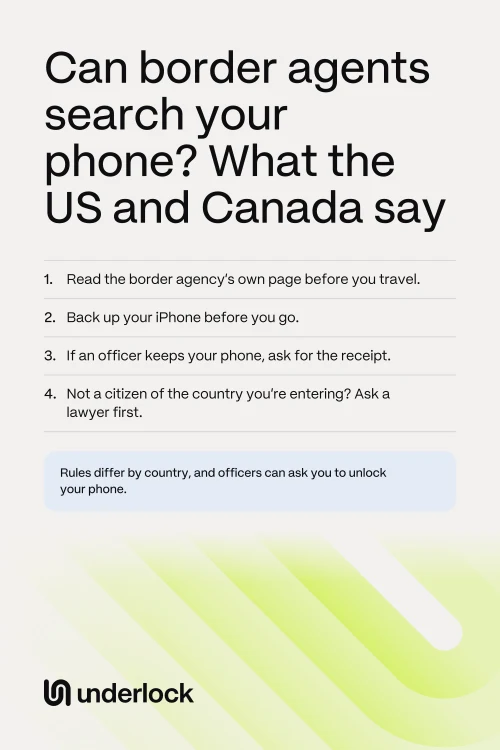
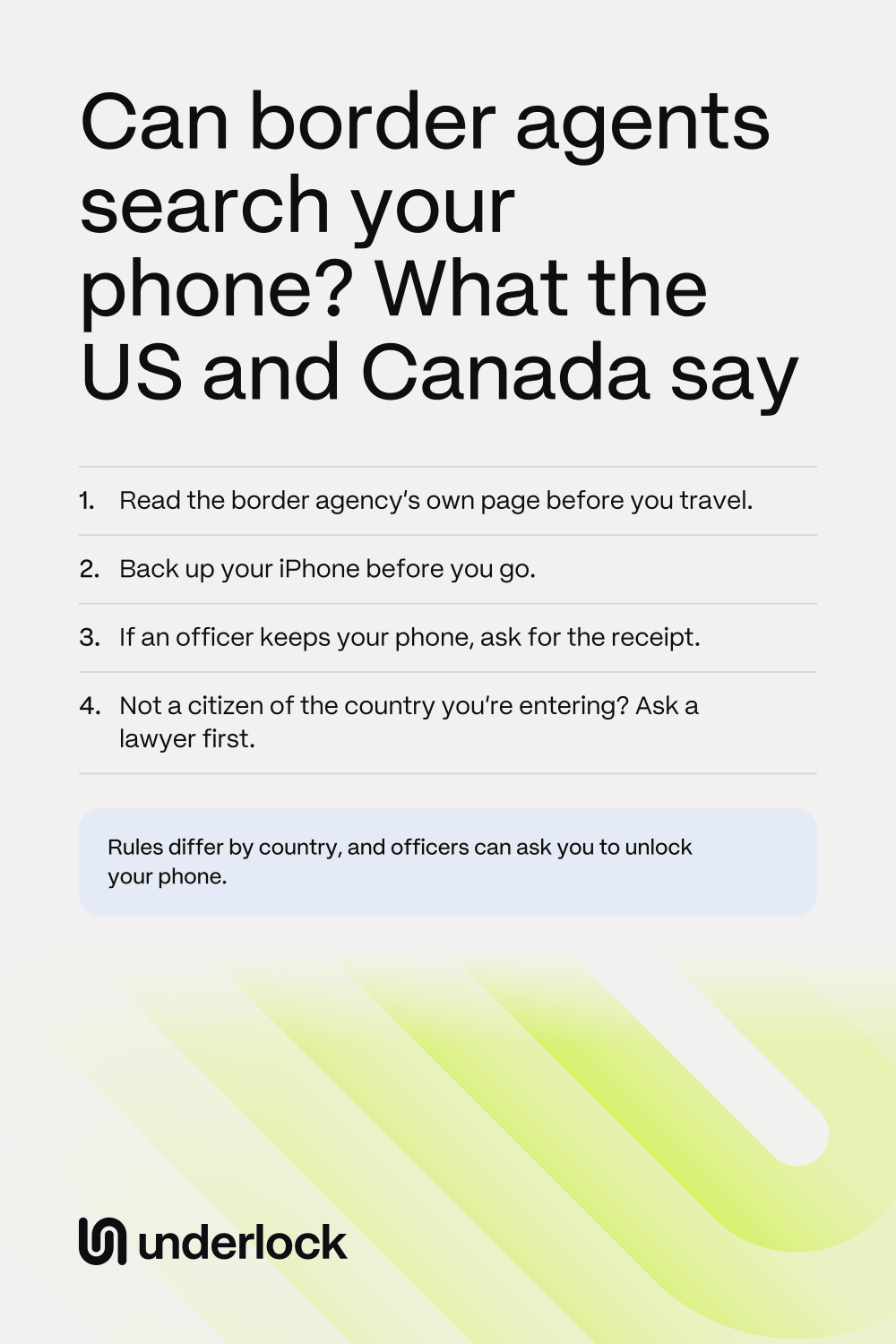
- Read the border agency’s own page for the country you’re entering: CBP’s page on searching devices, or the CBSA’s page on examining devices.
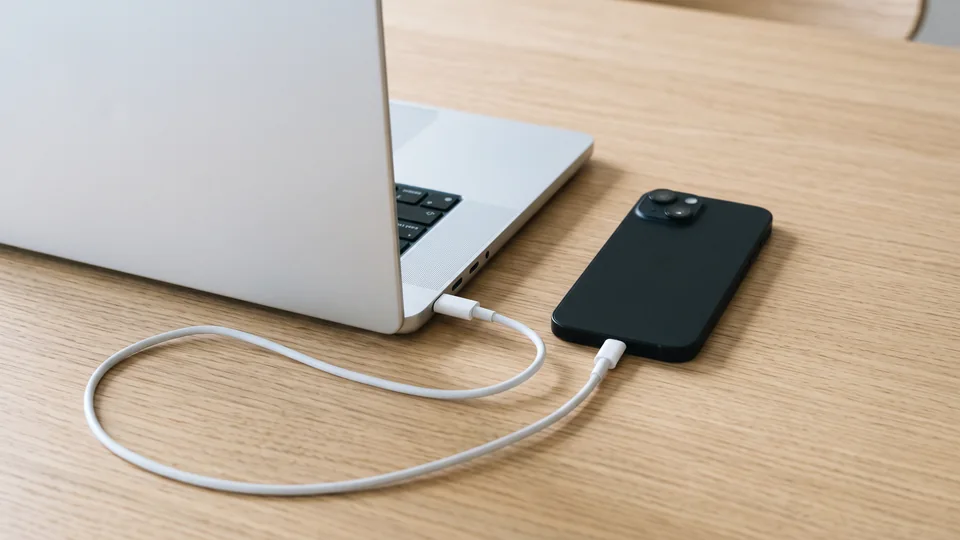
- Back up your iPhone before you go, so a phone that’s held, lost or stolen doesn’t cost you your photos. Apple’s steps to back up with iCloud
- If you aren’t a citizen of the country you’re entering, talk to an immigration lawyer before you travel.
- At the border, be honest with officers. Canada’s travel advice for the US says to comply and be forthcoming with border authorities.
- If an officer keeps your phone, ask for the receipt, and ask how to get your phone back.
Your private photos when you travel
We make Underlock, a private vault for photos, videos, files and notes. Underlock is for everyday privacy, at home and on a trip. Underlock doesn’t change what a border officer can ask to see, and that includes your vault.
Underlock is coming soon to the App Store. Here’s how it will work.
- Out of your camera roll. Photos in your vault aren’t in the Photos app, so they’re not in iCloud Photos. When you hand someone your iPhone to show a ticket or one photo, your private photos aren’t in the camera roll.
- If your iPhone is lost or stolen on a trip. Your vault opens with your own pattern, a shape you draw on a grid of dots, not your iPhone passcode or Face ID. So your passcode alone doesn’t open your vault.
- Encrypted on your iPhone. Everything you add to your vault is encrypted on your iPhone before it’s saved.
- Nothing on our servers. We never receive your files, your pattern or your keys, so we can’t open your vault for anyone or hand your files over.
- Underlock doesn’t change the rules. Your vault is on your iPhone, so an officer can ask you to open your vault too. Once you open your vault, an officer can see everything in your vault.
- The app shows on your iPhone. The Underlock icon is on your Home Screen, so people can see that Underlock is on your iPhone.
When an official asks to see your phone, here is what Underlock does, and what to do. That page covers the US, Canada, the UK and Australia.
Questions people ask
Yes, in both countries. CBP says its officers can look through a phone by hand even when they suspect nothing, and 3 US appeals courts agreed in 2026. The CBSA says its officers examine a phone only when they have signs that border laws were broken. See what changed in 2025 and 2026.
Yes. CBP’s rules cover every traveller, US citizens included. In CBP’s 2025 year, 13,590 of its 55,318 searches were of US citizens’ devices. CBP says a US citizen won’t be denied entry for not unlocking a phone, but the phone may be held.
If you refuse, your phone may be held. In the US, CBP may also weigh a refusal when it decides whether to let a foreign national in. In Canada, the CBSA says you are obligated to give your password, and a phone you don’t open may be held or seized. A lawyer can advise on your own situation.
In the US, CBP says a held phone should usually come back within 5 days, and managers can approve longer. You get a receipt, form 6051D. In Canada, the CBSA’s page gives no time limit. You have 90 days to ask the CBSA for a review.
In the US, yes. CBP searched the devices of 47,047 travellers in its 2024 year, and 55,318 in its 2025 year. From April to June 2026, CBP searched 19,732, a record for 3 months. In Canada, the CBSA examined the devices of 1,108 travellers in 2024, and 1,062 in 2025.
Yes, if an officer asks you to open your vault and you do. Underlock doesn’t change what an officer can ask you to open. We never receive your files, your pattern or your keys, so we can’t open your vault for anyone.